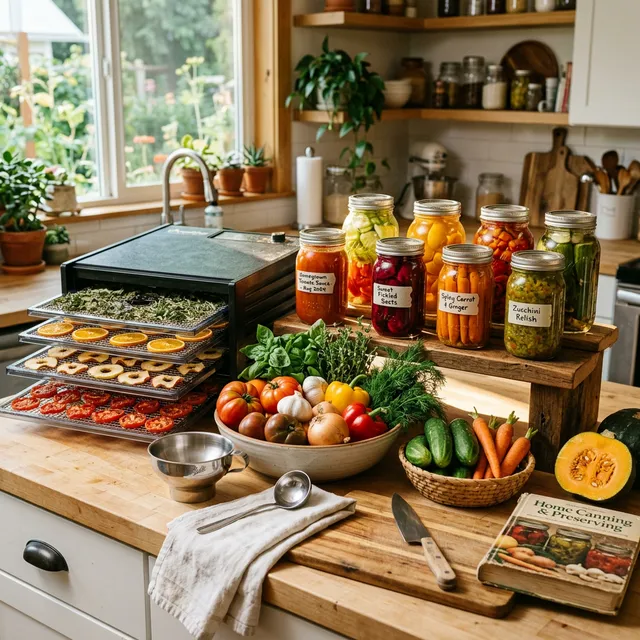
Home Food Preservation Basics
Quick Takeaways
- Know your acidity: High-acid foods (fruit, jams, pickles) can be canned in a boiling-water bath; low-acid foods (most vegetables, meat and seafood) require a pressure canner to reach temperatures high enough to prevent botulism.
- Use proper equipment: Glass jars, new lids and rings, jar lifters, canners, thermometers and tested recipes are essential.
- Never modify processing times or pressures – altering recipes may allow dangerous bacteria to survive.
- Freeze safely: Set freezers to –18 °C and refrigerators to 4 °C; a full freezer stays frozen for approximately 48 hours during an outage.
- Dry foods thoroughly: Dehydration removes moisture but does not kill all microbes, so maintain adequate drying temperature and store dried foods in airtight containers; freeze to extend shelf life.
- Label and date everything, and use preserved foods within a year for best quality.
- When in doubt, throw it out – bulging lids, off smells or signs of mould signal spoilage.
Who This Guide Is For and When It Matters in Canada
Home food preservation helps gardeners, urban balcony growers, bulk shoppers and anyone who wants to stretch their food budget or reduce waste. In remote communities where fresh produce is expensive or seasonal, preserving summer and autumn harvests can provide nutritious fruit and vegetables through winter. In urban apartments, small-batch jam or pickles maximise limited storage. During economic or supply disruptions, preserved foods supplement commercial supplies and reduce reliance on perishable goods. This guide is relevant year-round but especially useful during late summer and fall harvest seasons when Canadian produce is abundant.
Risk and Reality Check: Understanding Botulism and Safety
Improper canning can cause botulism, a potentially fatal illness caused by Clostridium botulinum bacteria. The toxin thrives in low-oxygen, moist environments – conditions found in improperly canned food. High-acid foods (pH < 4.6) like most fruits and pickles inhibit the bacteria; low-acid foods (pH > 4.6) such as vegetables, meats and mixtures require higher temperatures achievable only in a pressure canner. Using the wrong equipment or skipping steps (like adding lemon juice to tomatoes) can lead to contamination. Reusing lids, changing jar sizes or inventing new recipes increases risk. Freezing and dehydration are safer but still demand care: a freezer must remain at –18 °C (0 °F) to keep food safe, and dried foods should reach low water activity but microbes can survive if not dried thoroughly. Fermentation is generally safe when done correctly but requires clean equipment and salt brine; fermentation instructions should come from reliable sources [SOURCE NEEDED: safe fermentation guidelines].[1] [2]
What to Do: Today, This Week, and This Season
Today
- Determine your goals: Are you preserving garden produce, bulk grocery buys or seasonal deals? Start with simple projects like freezer fruit or refrigerator pickles.
- Gather equipment: Acquire or borrow canning jars, new lids and rings, a pot deep enough to cover jars by 2–3 cm of water, a jar lifter, and a digital thermometer. For low-acid foods, plan to use a pressure canner. Purchase freezer containers and resealable bags.
- Learn the basics: Read a current canning guide or take a workshop. Familiarise yourself with food acidity, headspace, processing times, and safe handling. Bookmark reputable resources and tested recipes.
- Start freezing: Wash and chop surplus fruits or vegetables; blanch vegetables briefly, cool, pat dry and pack into freezer-safe containers. Label with the date and freeze promptly.
This Week
- Try a water-bath recipe: Make a small batch of jam or pickles using a tested recipe. Ensure jars are hot, fill to the recommended headspace, wipe rims, apply new lids and rings, and process in boiling water for the specified time. Listen for the “ping” as jars seal during cooling.
- Prepare for pressure canning: If preserving low-acid foods like green beans or soups, borrow or purchase a pressure canner. Check the gasket and gauge, and practise operating it with water only.
- Explore dehydration: Slice apples, herbs or vegetables evenly. Set a dehydrator to at least 63 °C (145 °F). Dry until pieces are leathery and show no moisture when cut. Allow to cool, then store in airtight jars or vacuum-sealed bags. Freeze for longer storage[3].
- Organise storage: Designate a cool, dry, dark space for your jars and dried foods. Place a thermometer to ensure temperatures stay below 20 °C. Keep items off the floor to prevent moisture damage.
This Season
- Preserve the harvest: At peak season, can high-acid foods like peaches, applesauce, salsa and pickled cucumbers. Pressure-can low-acid items like vegetable soup or beans. Freeze extra berries, corn and peas in family-sized portions.
- Experiment with fermentation: Try fermenting sauerkraut or kimchi using a fermentation kit. Follow tested salt concentrations and maintain anaerobic conditions [SOURCE NEEDED: safe fermentation guidelines].
- Maintain equipment: Have pressure-canner gauges tested annually at a local extension office or hardware store. Replace worn gaskets and rusted racks.
- Inspect stored foods: Check jars for bulging lids, leaks or cloudy liquid. If in doubt, discard the contents without tasting. Use canned foods within a year for best quality.
- Review and adjust: Assess which preserved foods you used or enjoyed. Adjust quantities and recipes for next season. Plan to share surplus with neighbours or food banks.
The Step-by-Step Plan for Home Food Preservation
Step 1: Understand Acidity and Select Method
- High-acid foods (<4.6 pH): Fruits, jams, jellies, pickles and tomatoes acidified with lemon juice or vinegar can be safely processed in a boiling water bath.
- Low-acid foods (>4.6 pH): Most vegetables, meats, seafood and mixed dishes require a pressure canner to reach temperatures above 116 °C needed to destroy botulism spores.
- When uncertain, treat foods as low-acid or add approved acids per tested recipes. Never experiment with jar size, ingredients or times.
Step 2: Prepare Equipment and Ingredients
- Inspect and wash jars with hot, soapy water; rinse well. Use new lids every time.
- Gather canners (boiling or pressure), jar lifters, funnels, bubble removers, clean towels, a digital thermometer and timer. Prepare your chosen tested recipe.
- For freezing: Set freezer to –18 °C and have freezer-safe containers or bags ready.
- For drying: Ensure your dehydrator maintains at least 63 °C (145 °F) and has clean trays.
Step 3: Processing Methods
Canning (Water Bath)
- Preheat jars and water. Fill jars with hot food, leaving recommended headspace (often 1 cm). Remove air bubbles, wipe rims and apply lids and rings fingertip-tight.
- Place jars in the canner, cover with at least 2–3 cm of water and bring to a rolling boil. Start timing when water returns to a full boil. Process for the time specified in the recipe.
- Turn off heat, wait five minutes, then remove jars carefully. Cool without tilting. Listen for the seal “ping.” After 24 hours, check seals; refrigerated or re-process unsealed jars.
Pressure Canning
- Fill the canner with the recommended amount of water. Place filled jars on the rack and secure the lid. Vent steam for 10 minutes to expel air, then close the vent and heat to reach the prescribed pressure. Adjust heat to maintain pressure for the entire processing time.
- When time is up, turn off heat and let pressure return to zero naturally. Wait a few minutes, then open the lid away from your face. Remove jars and cool as above.
Freezing
- Blanch vegetables (e.g., beans, broccoli) in boiling water for a few minutes, then plunge into ice water. Drain and dry. Pack into freezer bags or containers, removing as much air as possible. Label with date and contents.
- Package fruits raw or with a light sugar syrup; freeze in single layers before stacking. Use within 6–12 months.
Dehydrating
- Slice foods uniformly. For apples and pears, dip slices in lemon juice to prevent browning. Spread on dehydrator trays without overlapping. Dry until pieces are leathery and moisture is not visible.
- Cool completely before packaging. Store in airtight jars or vacuum-sealed bags. For extra security, freeze dried foods for a week to kill any insect eggs.
Fermenting
- Clean equipment thoroughly. Submerge vegetables in a brine solution with the recommended salt concentration (often 2–3 % by weight). Use fermentation weights and airlocks to keep produce submerged and prevent oxygen exposure. Ferment at room temperature out of direct sunlight. Consult tested recipes for times and temperatures [SOURCE NEEDED: safe fermentation guidelines].[4]
Step 4: Storage and Inspection
- Label every jar or package with the contents and date. Use waterproof markers or dissolvable labels.
- Store canned goods in a cool (10–20 °C), dry, dark place; keep off the floor and away from heat sources. Freezer items should be at –18 °C. Dried foods prefer room temperature but out of moisture and light.
- Rotate using older items first. Plan meals that incorporate preserved foods before new harvests arrive.
- Inspect jars periodically. Discard any with bulging lids, leaks, unexpected cloudiness or off smells. Never taste questionable food.
Decision Points for Different Situations
- Apartment vs house: Apartment dwellers may lack space; focus on small batches, refrigerator pickles, freezing and dehydrating herbs. Houses with basements can store larger quantities and invest in pressure canners.
- Rural vs urban: Rural households with gardens may preserve large harvests; ensure proper equipment and storage space. Urban shoppers might preserve bulk produce from farmers’ markets or community supported agriculture (CSA) boxes.
- Time and budget: Water-bath canning and freezing are inexpensive entry points. Pressure canners and dehydrators require more investment; consider borrowing or community kitchens.
- Seasonality: Preserve when produce is abundant and cheap. Avoid canning low-acid vegetables out of season unless you have a pressure canner. Fermentation can be done year-round on small batches[5] [6].
Product Families Recommended for Home Food Preservation
Canning Starter Kits
Why it helps: Bundled kits simplify water-bath canning by including a deep pot, jar rack, funnel, jar lifter and sometimes a thermometer. Having the right tools makes the process safer and more efficient. What to look for:
- Pot deep enough to submerge jars with extra headspace
- Stable rack that keeps jars off the bottom
- Heat-resistant handles and comfortable jar lifter
- Enamel or stainless steel construction for durability Good / Better / Best: A basic kit includes an enamel stockpot with a canning rack and essential tools. Better kits feature stainless steel pots, magnetic lid lifters and bubble removers. The best kits add a built-in thermometer, glass measurer and recipe booklet. Affiliate links: [Affiliate link: Canning starter kits – option A] [Affiliate link: Canning starter kits – option B] [Affiliate link: Canning starter kits – option C]
Pressure Canners
Why it helps: Pressure canners reach temperatures high enough to safely process low-acid foods and mixed dishes. What to look for:
- Size and capacity (number of jars per batch)
- Dial or weighted gauge with accurate pressure control
- Safety features (locks, pressure relief valves)
- Compatibility with your stovetop (induction vs electric) Good / Better / Best: A good canner has a weighted gauge and holds 5–7 jars. Better models include both dial and weighted gauges with easy-read dials. The best units offer dual gauges, built-in pressure relief and induction compatibility. Affiliate links: [Affiliate link: Pressure canners – option A] [Affiliate link: Pressure canners – option B] [Affiliate link: Pressure canners – option C]
Canning Jars and Lids
Why it helps: Proper jars and new lids ensure a reliable seal and prevent contamination[7] [8]. What to look for:
- Mason-style jars made of heat-resistant glass
- Two-piece metal lids with replaceable flat discs and reusable rings
- Variety of sizes (250 ml, 500 ml, 1 L) for different foods
- Straight-sided jars for freezing if desired Good / Better / Best: Good jars come in standard sizes with regular-mouth lids. Better sets include wide-mouth jars for easier filling. The best sets feature tamper-evident lids, reusable glass lids with rubber gaskets and extra rings. Affiliate links: [Affiliate link: Canning jars and lids – option A] [Affiliate link: Canning jars and lids – option B] [Affiliate link: Canning jars and lids – option C]
Food Dehydrators
Why it helps: Dehydrators remove moisture efficiently, preserving fruits, vegetables and meats for lightweight storage. What to look for:
- Adjustable temperature settings with a range at least up to 70 °C (160 °F)[9] [10]
- Multiple stackable trays or shelves
- Even heat distribution and circulation fan
- Easy-to-clean trays and drip sheets Good / Better / Best: Good dehydrators have fixed or limited temperature controls and four to five trays. Better models offer precise temperature control, expandable trays and a timer. The best units provide digital control, large capacity, stainless steel trays and quieter operation. Affiliate links: [Affiliate link: Food dehydrators – option A] [Affiliate link: Food dehydrators – option B] [Affiliate link: Food dehydrators – option C]
Vacuum Sealers and Bags
Why it helps: Removing air from bags before freezing or storing dried foods reduces oxidation, freezer burn and insect contamination. What to look for:
- Strong, consistent seal
- Compatibility with a variety of bag sizes and rolls
- Dry and moist settings for different foods
- Accessory port for jar sealing attachments Good / Better / Best: A good sealer is compact with manual operation. Better models add automatic bag detection and pulse functions. The best systems include accessories like jar sealers, built-in bag cutters and adjustable vacuum strength. Affiliate links: [Affiliate link: Vacuum sealers and bags – option A] [Affiliate link: Vacuum sealers and bags – option B] [Affiliate link: Vacuum sealers and bags – option C]
Freezer Containers
Why it helps: Proper containers and bags protect food quality in the freezer and make portioning easy. What to look for:
- BPA-free plastic, silicone or glass rated for freezing
- Tight-fitting lids that prevent leaks
- Stackable shapes that maximise freezer space
- Options for single-serve and family portions Good / Better / Best: Basic freezer bags work for most foods. Better options include reusable silicone bags and plastic containers. The best sets offer glass or stainless steel containers with locking lids that go from freezer to oven. Affiliate links: [Affiliate link: Freezer containers – option A] [Affiliate link: Freezer containers – option B] [Affiliate link: Freezer containers – option C]
Fermentation Kits
Why it helps: Kits simplify fermenting vegetables by providing specialized jars, lids, weights and airlocks that keep oxygen out and allow gases to escape safely. What to look for:
- Food-grade glass or ceramic jars
- Airlock or water-seal lids to prevent mould
- Weights to keep food submerged
- Dishwasher-safe components for easy cleaning Good / Better / Best: A good kit includes a jar with vented lid and weight. Better kits offer multiple jars with stainless steel weights and silicone airlocks. The best sets include adjustable airlock lids, pH strips and recipe guides. Affiliate links: [Affiliate link: Fermentation kits – option A] [Affiliate link: Fermentation kits – option B] [Affiliate link: Fermentation kits – option C]
Digital Food Thermometers
Why it helps: Accurate thermometers ensure that foods reach safe temperatures during processing and reheating. What to look for:
- Fast, accurate readings (±1 °C)
- High temperature range suitable for canning and dehydrating
- Waterproof or water-resistant probes
- Easy-to-read display and hold function Good / Better / Best: Basic thermometers provide quick readings for meats. Better versions include long probes and waterproof housing. The best models have dual probes, programmable alarms and magnetic mounts for hands-free use. Affiliate links: [Affiliate link: Digital food thermometers – option A] [Affiliate link: Digital food thermometers – option B] [Affiliate link: Digital food thermometers – option C]
Labeling and pH Testing Supplies
Why it helps: Labels and pH strips help you track contents, dates and acidity levels for safe storage. What to look for:
- Dissolvable or waterproof labels that adhere well to jars and bags
- Fine-tip permanent markers or grease pencils
- pH test strips or digital meters with ranges suitable for food
- Storage for labels and testers Good / Better / Best: A good setup includes basic labels and a permanent marker. Better kits provide dissolvable labels and a pack of pH strips. The best kits add a digital pH meter with calibration solution and a label dispenser. Affiliate links: [Affiliate link: Labeling and pH testing supplies – option A] [Affiliate link: Labeling and pH testing supplies – option B] [Affiliate link: Labeling and pH testing supplies – option C]
Checklists for Home Food Preservation
Essential Food Preservation Kit Checklist
- For water-bath canning: Large pot with lid and rack, jar lifter, funnel, bubble remover, ladle, measuring cups, digital timer, new lids and rings, glass jars, clean towels.
- For pressure canning: Pressure canner with gauge or weighted regulator, rack, spare gasket, jar lifter, tested recipes.
- For freezing: Freezer set to –18 °C, vacuum sealer or freezer bags, reusable containers, marker and labels, baking sheets for pre-freezing, blanching pot and ice bath[11] [12].
- For dehydrating: Dehydrator or oven with temperature control, trays or racks, sharp knives, cutting board, lemon juice or ascorbic acid (for pretreating light-coloured fruits), airtight jars or vacuum bags.
- For fermentation: Fermentation jar or crock, weight, airlock lid or cloth cover, salt, measuring scale, pH test strips, clean utensils.
- For safety and monitoring: Digital food thermometer, refrigerator/freezer thermometer, pH meter (optional), cleaning supplies (soap, bleach solution).
Preservation Process Checklist
- Choose a tested recipe from a reputable source.
- Wash hands, equipment and surfaces thoroughly before starting.
- Prepare ingredients (wash, peel, chop) and measure accurately.
- Follow processing times and temperatures exactly.
- Avoid reusing lids or changing jar sizes.
- Cool and check seals before labeling and storing.
- Store in a cool, dark place and note the date.
- Periodically inspect stored goods for spoilage and discard if any signs appear.
Common Mistakes and Myths in Home Food Preservation
- Assuming all foods can be water-bathed. Low-acid foods require pressure canning to destroy botulism spores.
- Reusing lids or inventing recipes. Used lids may not seal properly, and untested recipes can give unsafe pH or times.
- Skipping acid in tomatoes. Many tomato varieties are borderline; adding lemon juice or vinegar ensures safe acidity.
- Changing jar sizes or reducing headspace; doing so may alter heating times and leave bacteria alive.
- Not blanching vegetables before freezing. Blanching preserves colour and texture and kills surface bacteria[13] [14].
- Using dehydrators without temperature control. Low temperatures may not inhibit bacteria or mould.
- Neglecting labels; without dates and contents you may forget to use foods before quality declines.
When to Escalate and Seek Help
If you notice a broken seal, bulging lid, unusual odour or mould growth, discard the food without tasting. If anyone exhibits symptoms of botulism (nausea, vomiting, double vision, muscle weakness) after eating home-preserved food, seek immediate medical care. Consult local public health or a home-economics extension service if you’re unsure about a recipe or processing method. During power outages, monitor freezer and refrigerator temperatures; if foods thaw and warm beyond safe temperatures for more than two hours, discard them.
Sources
- Ensuring Safe Canned Foods - National Center for Home Food Preservation
- Botulism — Home-Canned Foods | Botulism | CDC
- K-State Extension Cottonwood District — Dehydrating Foods
- Preventive control recommendations for manufacturing fermented and dried meat products - inspection.canada.ca
- Clostridium botulinum | UMN Extension
- For Safety's Sake - National Center for Home Food Preservation
- Recommended Jars and Lids - National Center for Home Food Preservation
- Ensuring a Good Seal on Canned Goods
- Heat-penetration studies - inspection.canada.ca
- GettyStewart.com — Recommended Temperatures for Dehydrating Different Foods
- Interactive tool on food safety
- Poultry and rabbit meat refrigeration, chilling, and freezing procedures - inspection.canada.ca
- Projects - National Center for Home Food Preservation
- How to blanch vegetables for safe preservation | UMN Extension