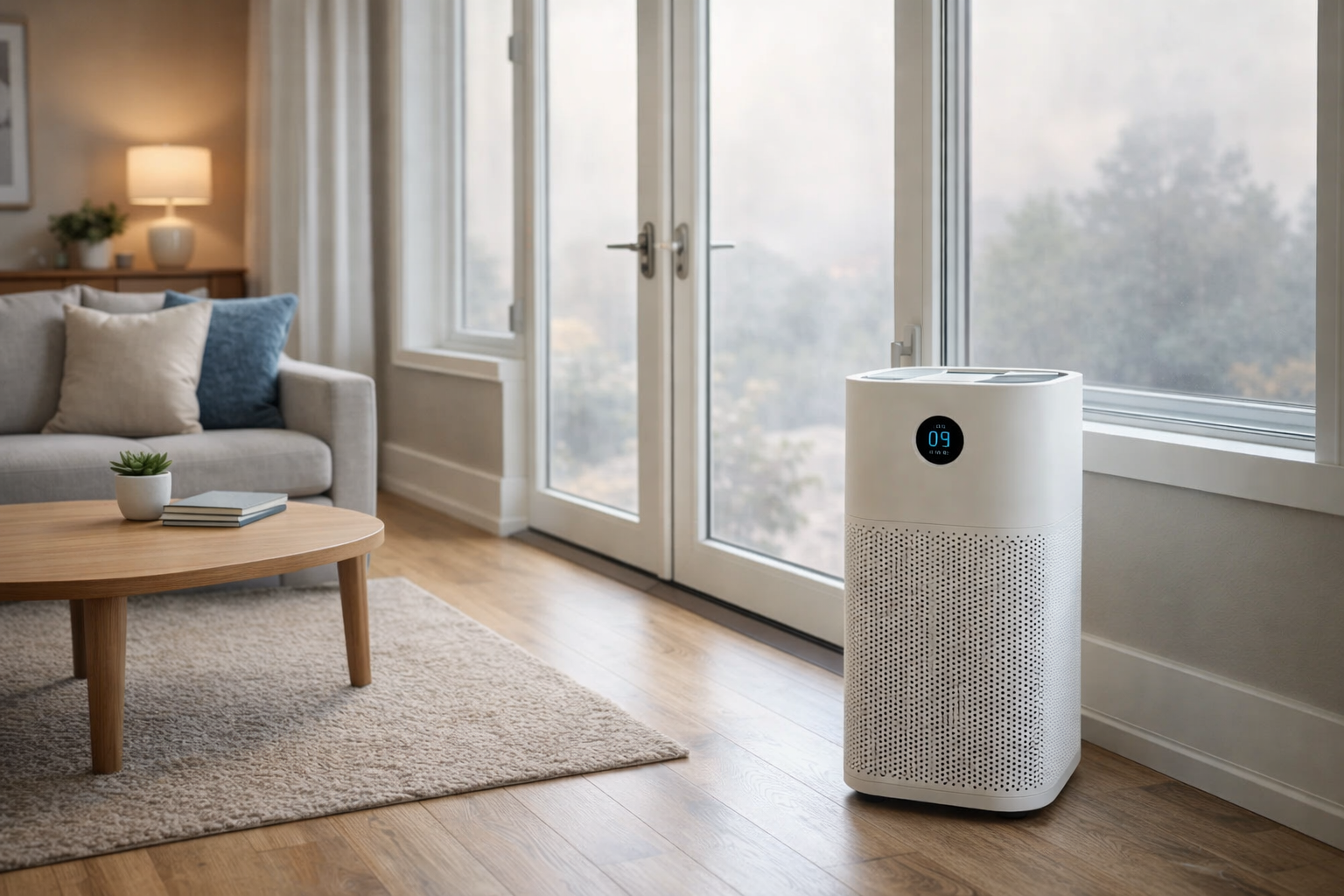
Clean air under threat: building a wildfire smoke action plan
Quick takeaways
- Check air quality regularly. Use the Air Quality Health Index (AQHI) or local alerts to monitor smoke conditions and adjust activities accordingly[1].
- Seal your space. Close windows and doors during smoke events and use weatherstripping or draft stoppers to reduce smoke infiltration.
- Filter indoor air. Upgrade furnace filters to the highest-quality filter your system can handle and run certified HEPA air purifiers to remove fine particles.
- Respiratory protection matters. Keep well-fitting, NIOSH-certified N95 or equivalent respirators (KN95, KF94) for each household member; they reduce inhalation of fine smoke particles.
- Prepare for power outages. Wildfire smoke events often coincide with power interruptions. Have portable power stations or battery banks to run purifiers and charge phones.
- Plan ahead. Identify a “cleaner air room” and gather supplies such as DIY air cleaner components (box fan, MERV 13 filters), a weather radio, and a go-bag in case evacuation is ordered.
Who this is for / when this matters in Canada
Wildfire smoke impacts communities across Canada, from urban centres to rural boreal forests. In recent years, smoke from major fires in British Columbia, Alberta, and the boreal north has spread across the Prairies into central and eastern provinces. Wildfire season typically peaks from late spring through early fall, but some areas see smoke as early as April or as late as October. This guide is intended for households in all regions—whether you reside in a coastal apartment, prairie farmhouse, or northern town. Families with seniors, young children, or individuals with respiratory conditions gain the most from proactive air-quality plans, but everyone should prepare since smoke can travel thousands of kilometres[2] [3].
Risk and reality check
Wildfire smoke contains fine particulate matter (PM₂.₅) and gases that can irritate eyes, throat, and lungs. Government guidance states that a properly worn NIOSH-certified N95 respirator reduces exposure to fine particles but not gases. Higher-risk groups include people with asthma, chronic obstructive pulmonary disease (COPD), heart disease, pregnant individuals, infants, and older adults. Smoke events can last days or weeks; merely staying indoors and avoiding strenuous activity may be insufficient if smoke enters your home. However, simple measures—like sealing gaps, using HEPA filters, and monitoring local air quality—can significantly cut exposure. Mental health is also important; prolonged smoke and evacuation warnings can be stressful. Remember that events do end, and seeking support from friends, community leaders, or healthcare providers is encouraged.
What to do today / this week / this season
Today
- Register for AQHI or provincial air-quality alerts and bookmark a local air-quality website or app.
- Inspect windows and exterior doors for gaps; install or replace weatherstripping to create tighter seals.
- Check your home’s existing air filters, noting their size and rating (MERV or HEPA), and replace dirty filters.
- Purchase at least one N95 respirator per household member, fit-test for a proper seal, and store in a clean, dry place.
- Identify a room to serve as your “cleaner air space” during smoke events, ideally one with few windows and doors, like a bedroom.
This week
- Upgrade your filtration: Buy and install the highest-quality furnace filter your system can handle, typically MERV 13 or higher.
- Acquire or build a portable air cleaner: Certified HEPA air purifiers remove fine particles; ensure proper sizing. For a cost-effective option, build a DIY air cleaner using a certified box fan and MERV 13 filters, following safety guidance such as using a fan with a fused plug and never leaving it unattended.
- Assemble an air-quality kit: Include respirators, sealed eye drops, a battery-powered radio, spare filters, duct tape, and a contact list (doctor, neighbours, local emergency line). Store the kit in your cleaner-air room.
- Prepare for power outages: Purchase a portable power station or power bank capable of running your air purifier for several hours, then charge and test it.
This season
- Schedule HVAC maintenance: Have a professional inspect and service your furnace or heat pump, and ensure ducting is sealed.
- Discuss evacuation plans with family: Decide on a destination if an evacuation order is issued and pack a go-bag with essentials like medications, important documents, and basic supplies (see Guide 2 for a detailed checklist).
- If you live in a wildfire-prone area, implement FireSmart measures around your home, such as clearing flammable debris and maintaining a 1.5-metre non-combustible zone, to reduce ember ignition risks.
The plan (step‑by‑step)
- Monitor air quality and alerts: Start each day by checking the AQHI or provincial alerts. If the index reaches 7 (high) or above, limit outdoor activities and prepare to activate your cleaner-air space.
- Seal your home: When smoke arrives, close windows and doors. Use damp towels or draft stoppers at door bases to reduce infiltration. In winter, balance sealing with ventilation needs; open windows briefly if indoor air becomes stale.
- Run air purifiers: Start your central HVAC fan on recirculation mode and run certified HEPA air purifiers continuously in the cleaner-air space. For apartments without HVAC, rely on portable units. Keep replacement filters on hand.
- Use respirators when going outside: If you must leave home, wear a properly fitting N95 or equivalent respirator. Children under two or people who cannot remove a mask unaided should not use respirators; instead, limit exposure by staying indoors.
- Stay hydrated and take breaks in cleaner air: Drink plenty of water to soothe airways. If indoor air quality worsens, visit local “cleaner air” spaces like community centres when available.
- Prepare to evacuate: If authorities issue an evacuation order or the AQHI remains very high (10+) for prolonged periods, grab your go-bag and follow designated routes. Close HVAC systems, turn off air conditioning, and lock doors upon leaving.
- After the smoke clears: Once outdoor air quality improves, ventilate your home by opening windows and doors. Wet-mop surfaces and vacuum with a HEPA vacuum to remove settled particles. Replace filters and test smoke detectors and carbon monoxide alarms.
Make the plan fit your situation
- Apartment vs. house: Apartment dwellers often have limited HVAC control; depend on portable air cleaners and communicate with building management about upgrading common-area filters. Detached homeowners can invest in whole-house filtration and structural improvements.
- Rural vs. urban: Rural residents may face longer smoke exposure and more frequent power outages; consider larger power stations or generators. Urban households might access community clean-air shelters more easily.
- Vehicle vs. no vehicle: With a vehicle, keep N95 masks and a small air cleaner in your car; set ventilation to recirculation mode when driving through smoke. Without a vehicle, plan for public transit or community evacuation assistance and keep your kit light.
- Winter vs. summer: In winter, stay warm by balancing sealing with safe heating; avoid wood stoves during smoke events. In summer, when heat and smoke coincide, prioritize cooling with air conditioning and fans while filtering air.
Product families recommended
N95 respirators
Why it helps: A correctly worn NIOSH-certified N95 respirator filters at least 95% of airborne particles, including fine smoke particles.
What to look for:
- Certification (NIOSH, CSA, or equivalent); avoid counterfeit products.
- Adjustable nosepiece and head straps for a snug fit.
- Multiple sizes for adults and older children (respirators are not recommended for children under two).
- Cup-shaped or fold-flat designs based on comfort.
Good / Better / Best:
- Good: Basic single-use N95 respirators without exhalation valves.
- Better: Foldable KN95 or KF94 respirators with multi-layer filtration.
- Best: Reusable elastomeric respirators with replaceable P100 filters for repeated exposure.
[Affiliate link: N95 respirators – option A] [Affiliate link: N95 respirators – option B] [Affiliate link: N95 respirators – option C]
HEPA air purifiers
Why it helps: Certified portable air cleaners with high-efficiency particulate air (HEPA) filters remove fine particles from indoor air.
What to look for:
- Clean Air Delivery Rate (CADR) appropriate for room size[4] [5].
- True HEPA (H13) filter rating; avoid “HEPA-type” filters.
- Quiet operation and low energy consumption.
- Replacement filter availability and cost.
- Option for activated carbon stage to reduce odours.
Good / Better / Best:
- Good: Compact HEPA purifiers suitable for bedrooms (CADR 150-200 cfm).
- Better: Medium-room units with smart sensors and auto mode.
- Best: Large-room purifiers with dual filters, multiple fan speeds, and energy-efficient motors.
[Affiliate link: HEPA air purifiers – option A] [Affiliate link: HEPA air purifiers – option B] [Affiliate link: HEPA air purifiers – option C]
DIY air cleaner supplies
Why it helps: Do-it-yourself (DIY) air cleaners using a box fan and MERV 13 filters offer an affordable, short-term solution when certified purifiers are unavailable.
What to look for:
- A new (2012 or later) box fan with a fused plug to reduce fire risk[6] [7].
- MERV 13 or higher furnace filters sized to fit the fan.
- Duct tape or velcro straps to secure filters to the fan.
- Avoid leaving the unit unattended or running overnight.
Good / Better / Best:
- Good: Single-filter “Corsi–Rosenthal box” configuration using one box fan and one filter.
- Better: Four-filter cube design for greater airflow.
- Best: Professional DIY kit with pre-cut panels and safety features.
[Affiliate link: DIY air cleaner supplies – option A] [Affiliate link: DIY air cleaner supplies – option B] [Affiliate link: DIY air cleaner supplies – option C]
Indoor air quality monitors
Why it helps: Monitors provide real-time data on particulate levels and alert you when filtration or sealing measures need adjustment[8] [9].
What to look for:
- Ability to measure PM₂.₅ concentrations and, optionally, volatile organic compounds (VOCs).
- Smartphone connectivity for alerts and trend tracking.
- Battery-powered options for use during outages.
Good / Better / Best:
- Good: Compact PM₂.₅ monitors with basic display.
- Better: Wi-Fi-enabled monitors with app integration.
- Best: Multi-parameter air quality stations monitoring temperature, humidity, and pollutants.
[Affiliate link: Indoor air quality monitors – option A] [Affiliate link: Indoor air quality monitors – option B] [Affiliate link: Indoor air quality monitors – option C]
Weather radios
Why it helps: A battery-powered or hand-crank weather radio receives public weather alerts and evacuation notices even when internet and cellular networks fail.
What to look for:
- NOAA Weather Radio or Environment Canada Weatheradio compatibility.
- Multiple power options (battery, solar, hand-crank).
- Built-in flashlight and USB charging port.
Good / Better / Best:
- Good: Basic battery-powered AM/FM weather radio.
- Better: Hand-crank radio with USB charging for phones.
- Best: Multi-band emergency radio with built-in solar panel and integrated flashlight.
[Affiliate link: Weather radios – option A] [Affiliate link: Weather radios – option B] [Affiliate link: Weather radios – option C]
Portable power stations
Why it helps: Portable lithium-ion power stations keep air purifiers, lights, and communications devices running during power outages.
What to look for:
- Battery capacity measured in watt-hours (Wh); select a capacity that can run your purifier for the desired duration.
- Pure sine-wave output for sensitive electronics[10] [11].
- Multiple charging options (AC, solar panel, car).
- Weight and portability for easy movement.
Good / Better / Best:
- Good: Small 300 Wh units for charging phones and small purifiers.
- Better: Mid-sized 500–1000 Wh stations with multiple AC outlets.
- Best: High-capacity units (1500 Wh or more) with solar panels for extended outages.
[Affiliate link: Portable power stations – option A] [Affiliate link: Portable power stations – option B] [Affiliate link: Portable power stations – option C]
Window and door seals
Why it helps: Weatherstripping and draft stoppers reduce smoke infiltration, improve energy efficiency, and maintain indoor comfort.
What to look for:
- Self-adhesive foam or rubber strips sized for your window and door frames.
- Door sweeps to seal the gap at the bottom of exterior doors.
- Ease of installation and durability.
Good / Better / Best:
- Good: Basic foam weatherstripping tape.
- Better: Silicone or EPDM rubber seals with longer life.
- Best: Metal-reinforced weatherstripping systems with adjustable door sweeps.
[Affiliate link: Window and door seals – option A] [Affiliate link: Window and door seals – option B] [Affiliate link: Window and door seals – option C]
Checklists
Air‑quality kit checklist
- Install AQHI/weather alert app
- Inspect and seal windows and doors
- Have N95 respirators (one per person)
- Prepare HEPA air purifier or DIY cleaner with spare filters
- Obtain an indoor air quality monitor
- Get a weather radio and extra batteries
- Secure a portable power station or power banks
- Gather duct tape, draft stoppers, and towels
- Pack a go-bag with essentials (refer to Guide 2)
Cleaner‑air room setup checklist
- Choose a room with minimal windows and doors
- Seal doors and windows with weatherstripping and towels
- Set up a properly sized HEPA air purifier
- Have a DIY air cleaner ready as backup
- Store respirators, eye drops, water, and entertainment (books, games)
- Place first aid kit and flashlights close by
- Test the setup in non-emergency times for comfort
Common mistakes / myths
- “Any mask will do.” Surgical or cloth masks do not filter fine smoke particles; only well-fitting N95 or equivalent respirators provide adequate protection[12] [13].
- “I can leave the purifier off when I’m at home.” Smoke particles can infiltrate quickly; run your purifier continuously during smoke events and replace filters regularly.
- “Opening windows briefly to cool down won’t matter.” Even short periods of open windows can allow significant smoke indoors. Instead, prioritize keeping cool with fans, air conditioning, and staying in public clean-air spaces.
- “DIY air cleaners are always safe.” DIY units using box fans and filters can be effective but pose fire risks if used incorrectly; use fans with fused plugs, don’t leave them unattended, and change filters often.
- “I don’t need a plan if I’m healthy.” Even people without pre-existing conditions can experience irritation or reduced lung function during smoke events; preparation reduces discomfort for everyone.
When to escalate
- Call your healthcare provider or local telehealth line if you or a household member experiences chest pain, shortness of breath, or severe cough during a smoke event[14] [15].
- If indoor air remains smoky despite filtration efforts, consider going to a cleaner-air shelter identified by your local health authority.
- Evacuate immediately when authorities issue an order or if wildfire flames threaten your neighbourhood.
- Dial 9-1-1 for emergencies. If you or someone you know is in crisis or thinking about self-harm during a smoke event, call or text the 9-8-8 Suicide Crisis Helpline.
Sources
- Air Quality Health Index (AQHI) - Environment Canada
- Copernicus: Large smoke transport from Canadian wildfires reaches Europe | Copernicus
- Europe experiences significant transport of smoke from Canada wildfires | Copernicus
- AHAM Verifide - — Air Filtration Standards - AHAM Verifide
- Air purifiers - Natural Resources Canada
- US EPA — Research on DIY Air Cleaners to Reduce Wildfire Smoke Indoors | US EPA
- National Collaborating Centre for Environmental Health | NCCEH - CCSNE — Do-it-yourself (DIY) air cleaners: Evidence on effectiveness and considerations for safe operation
- National Air Pollution Surveillance (NAPS) Program - Open Government Portal
- Real-Time Air Quality Monitoring Systems | Aeroqual
- Renogy CA — Renogy 3000W 12V Pure Sine Wave Inverter | Renogy Canada | Renogy CA
- PowerInverters.com — Power Inverters Canada | Premium DC to AC Power Inverters
- Using masks to protect public health during wildfire smoke …
- N95 respirator and surgical mask effectiveness against respiratory viral illnesses in the healthcare setting: A systematic review and meta‐analysis - PMC
- Washington State Department of Health — Smoke From Fires | Washington State Department of Health
- Wildfire Smoke and Your Health